The short version
Microsoft Bob was Microsoft's 1995 attempt to replace the Windows desktop with a cartoon house. It lasted about a year, sold roughly 58,000 copies against expectations of millions, and became one of the company's most famous flops. Its legacy outlived it: Rover the dog, Comic Sans, and Clippy all trace back to Bob.
What it was
Microsoft Bob was a replacement interface for Windows 3.1 and Windows 95, released March 10, 1995, under the codename "Utopia". It was discontinued in early 1996, about a year after launch.
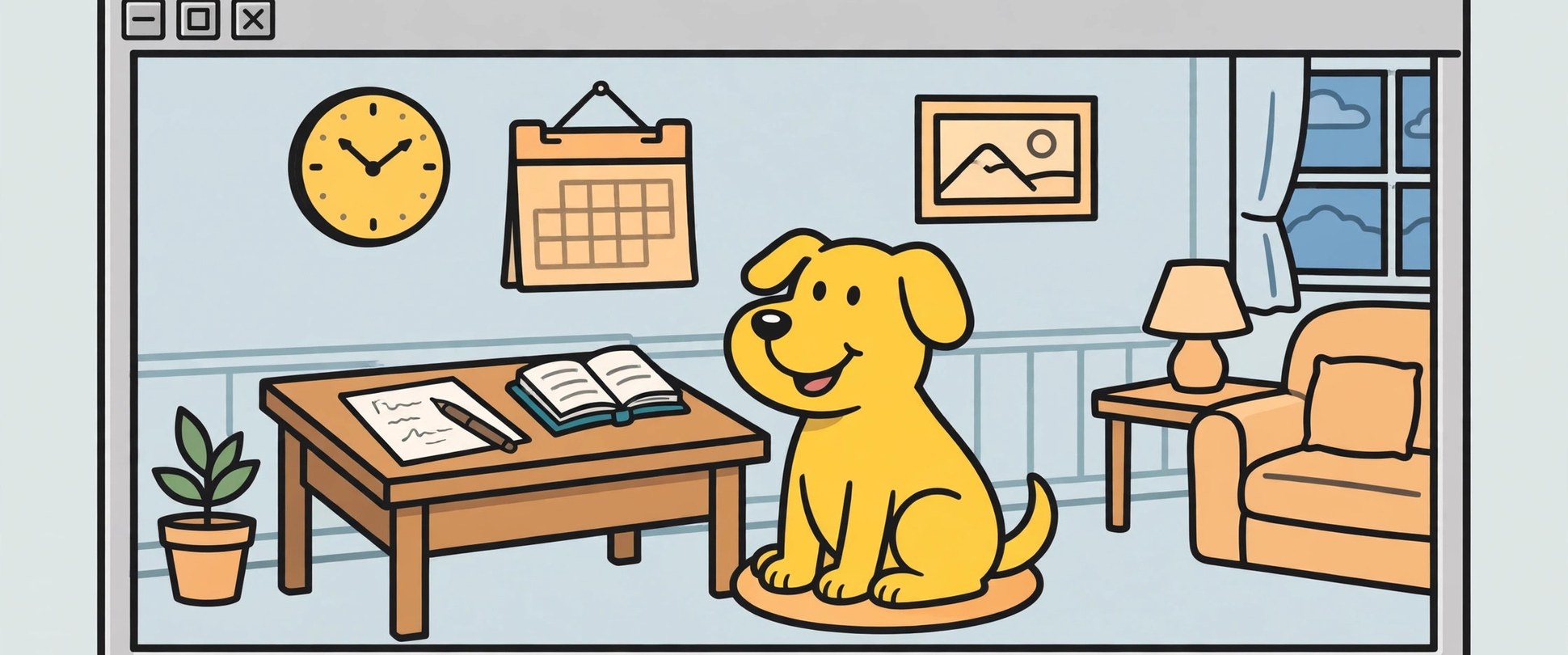
Instead of the Program Manager desktop, Bob showed a virtual house. The user moved between rooms, and each piece of furniture was an application: pen and paper on the desk opened the word processor, a checkbook opened the finance app, a clock opened the calendar. Cartoon assistants guided the user with speech balloons, led by Rover, a yellow dog. Other guides included a rat, a cat, and a caricature of William Shakespeare.
The project was led by Karen Fries, a Microsoft researcher. The design drew on research by Stanford professors Clifford Nass and Byron Reeves on how people treat computers like people. Melinda French — later Melinda Gates — worked on the product and marketing side as a marketing manager for multimedia products, and later became General Manager of Information Products. She left Microsoft in 1996.
What was inside
Bob shipped with a small suite of built-in applications:
- Letter Writer — basic word processor
- Checkbook — financial tracking
- Household Manager — maintenance lists, household records, vacation planning
- Financial Guide — advice on life milestones like buying a home
- GeoSafari — educational geography game
- Calendar — calendar and to-do list
- Email — early email client, via MCI Mail
- Address Book
- Clock — timers and alarms
Bob could install new applications, but only one add-on was ever released: Microsoft Great Greetings.
Why it failed
- Sales: about 58,000 copies sold (PC Data), against Microsoft's expectation of millions — the scale of Microsoft Works and Encarta.
- Price: around $100, a steep ask for something most people could not tell was a tool or a game.
- Requirements: 8 MB of RAM and 30 MB of disk, heavy for a typical home PC of the time, and slow unless the machine was fast.
- Reception: reviewers panned the childish look and the endless tutorial speech bubbles that had to be clicked through. PC World ranked it #7 on its list of the 25 worst tech products of all time; CNET called it the worst product of the decade; Time put it on its 50 Worst Inventions list.
- Timing: Windows 95 launched five months later with a normal desktop, and Bob became redundant overnight.
What it left behind
Bob failed, but three things outlived it:
- Rover returned in 2001 as the Search Companion in Windows XP.
- Comic Sans was designed by Microsoft type designer Vincent Connare for Bob — Rover's speech rendered in Times New Roman looked wrong coming from a cartoon dog. The font missed Bob's ship date and debuted in 3D Movie Maker, then Windows 95.
- Clippy, the Office Assistant in Office 97 through Office 2003, descended directly from Bob's helper concept.
- Microsoft even hid an encrypted copy of Bob on Windows XP install CDs to take up space and discourage piracy.
References
- Microsoft Bob — Wikipedia: https://en.wikipedia.org/wiki/Microsoft_Bob